Conservation Spotlight
What 5,000 sightings say about Snake Road
Fifty years after the first closure, citizen science and a few decades of weather data show where the calendar and the snakes have drifted apart.
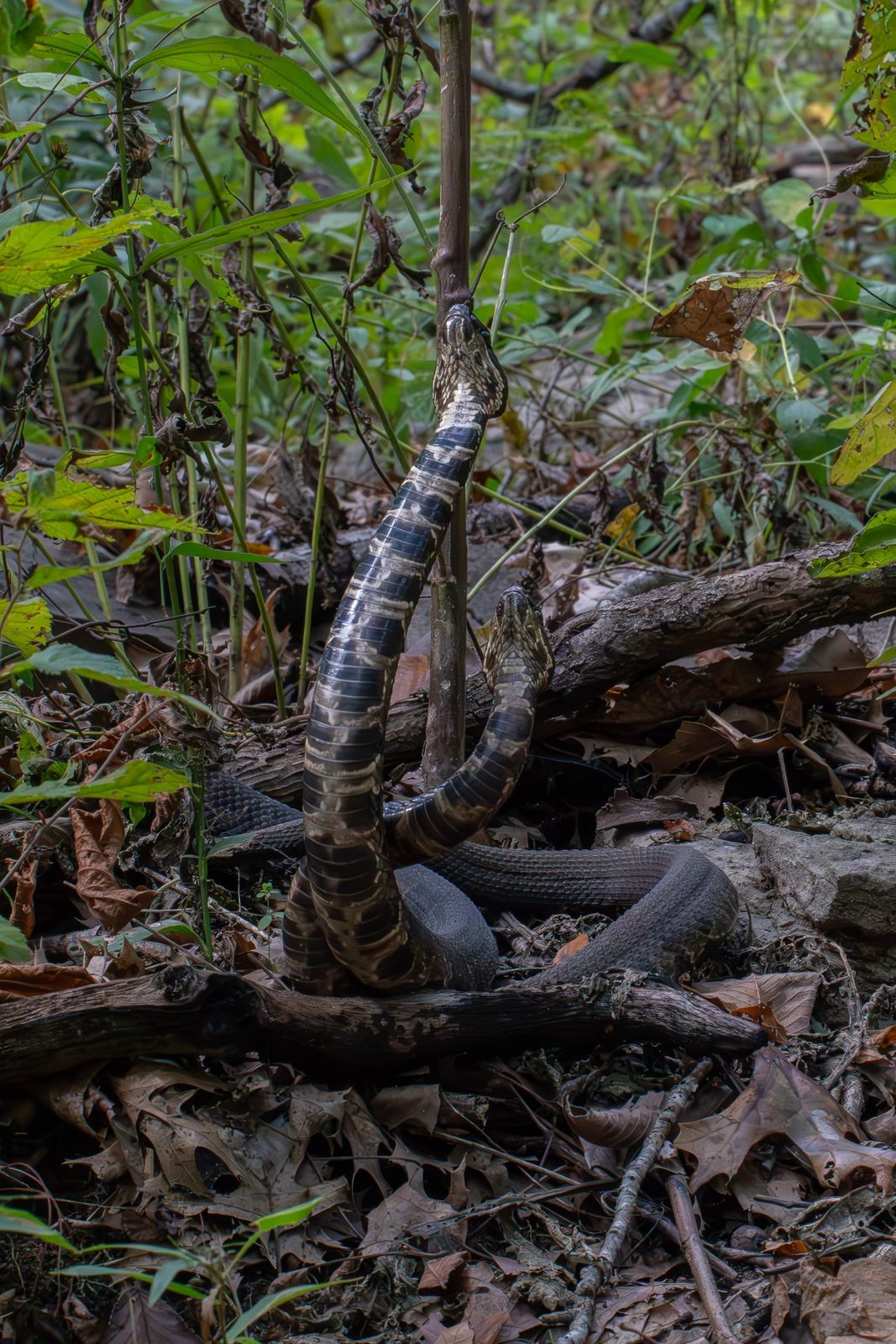
Snake Road has always been symbolic of home to me. As a little kid chasing snakes in southern Illinois, the idea of an area filled with serpents always loomed large in my mind. Stories of the road filled my imagination with a forest floor moving, like a magic carpet of wildlife. As I got older and began visiting the road, my imagination was put to rest as I learned more about the area, but my mind wandered elsewhere to the habits, preferences, and lifestyle of the wild residents of the area.
Snake Road, officially Forest Road 345, is a 2.5-mile gravel road at the foot of the LaRue-Pine Hills bluffs in Shawnee National Forest in southern Illinois. Many snakes spend the winter in dens in the bluffs and the summer in LaRue Swamp on the other side of the road, so twice a year they have to cross it, much to the delight of naturalists and those curious about this deeply misunderstood group of animals.
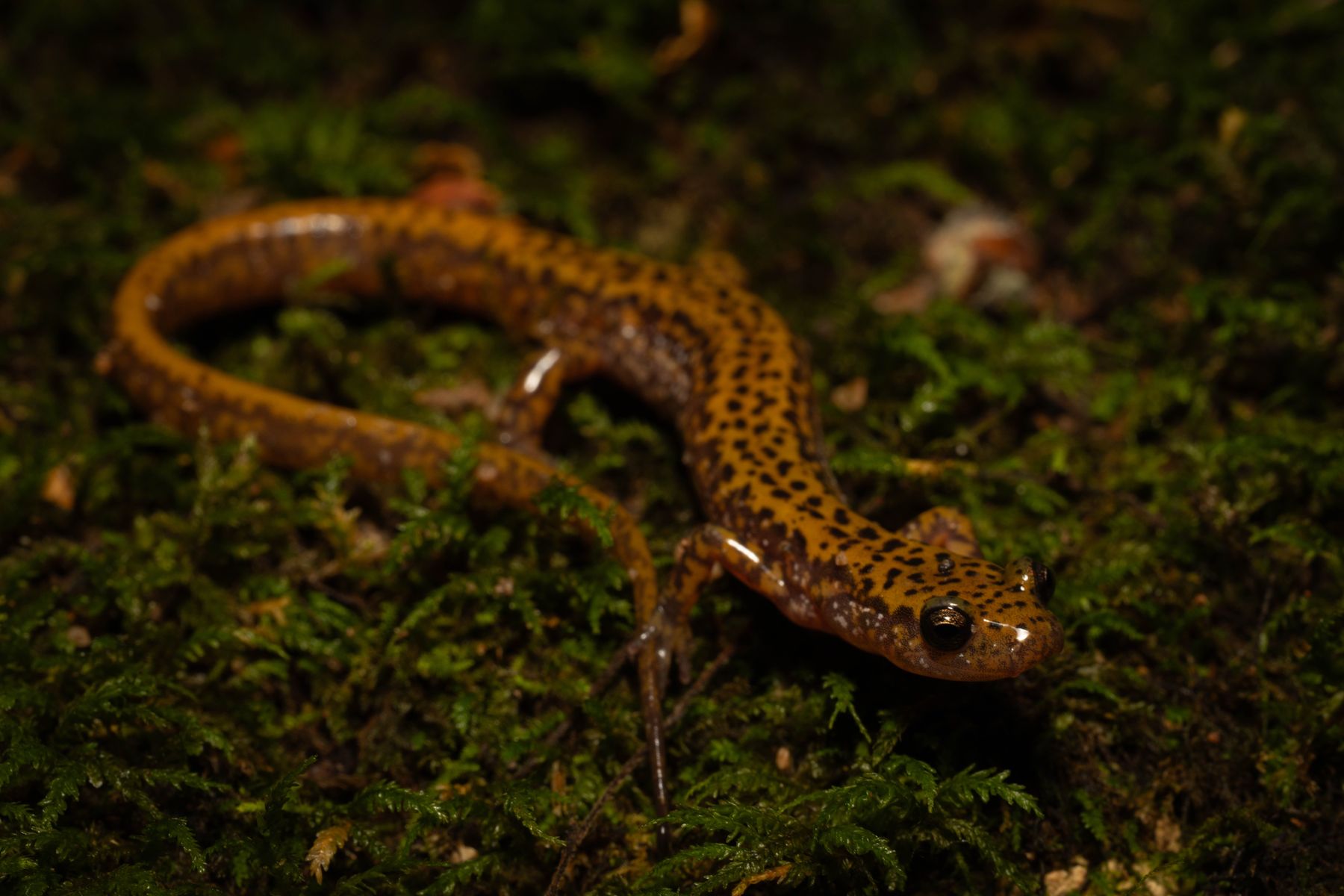
I have for a long time been fascinated with the habits of the snakes of LaRue-Pine Hills, and I wanted to dig a bit deeper into how their movement is influenced by weather patterns. The results of this digging started me questioning how effective the current road closures are and how climate change may affect herpetological migrations on the road in the future. This article summarizes my work on these questions and poses some important questions for the future of the road.
The Problem
For about the past 50 years, the road has been closed on fixed dates in the spring and fall so the reptile and amphibian migration can happen with as few road deaths as possible. The first closures, in 1972, lasted three weeks each season (Mominee, 2001). Surveys from 1987 to 1993 by Scott Ballard, now a state biologist (Ballard, 1994), showed that the movements lasted much longer, and the closures were stretched to the dates still used today: March 15 to May 15 and September 1 to October 30 (U.S. Forest Service, 2012). When the closures were set, they were a huge step in the conservation of, and general mindset towards, the world’s most persecuted animals. Unfortunately, road mortality still occurs outside the closures. In 2016, herpetologist John Palis walked the road in early November, after it reopened, and 42% of the snakes he came across on the road were dead (Palis, 2016). Recently, the Forest Service has closed the road early in warm springs, in 2022, 2024, and 2025 (Gazette-Democrat, 2022; Palmer, 2024; U.S. Forest Service, 2025). Even with this flexibility, warm days outside the closures are projected to become more common with climate change, and I believe road mortality will increase in the area unless change occurs.
What I Looked Into
The question I wanted to answer was pretty simple: when is it warm enough for animals to be crossing Snake Road, and is the road closed when they are?
First, I gathered every reptile and amphibian record logged on iNaturalist around the road since 1990 (GBIF.org, 2026a, 2026b). After cleaning out duplicates and anything not identified to species, I had about 5,500 records to work with. For the crossing estimates, I mostly used records within about 800 feet of the road.
Next, I matched each record to the weather on the day it was logged (Thornton et al., 2022). Spring and fall work a bit differently here. In spring, it isn’t just about one warm day. Animals coming out of winter need weeks of warming before they start moving, so a single nice afternoon in February usually isn’t enough. To account for this, I kept a running total of how much warmth had built up since January 1, which biologists call degree-days. This isn’t just a hunch. A study of timber rattlesnake (Crotalus horridus) dens in Illinois found that the day’s high temperature and accumulated degree-days together best predicted when snakes came to the surface (Jesper et al., 2023). In fall, the animals are already active, so what matters most is how warm that particular day is. Almost no snakes or frogs were logged on fall days colder than about 62 °F, so I treated any day at 62 °F or warmer as a day they could be out moving.
Last, I used those cutoffs to look at every year since 1981, including all the years nobody was out there looking. Then I did the same thing with future temperatures from seven climate models (Haarsma et al., 2016; Zippenfenig, 2023) to see what the 2030s and 2040s might look like.
Obviously more than just temperature goes into the movement and habits of herpetofauna, but for this project I wanted to keep it as simple as possible and see what trends emerged.
It’s worth noting that the records spike the day the road closes and crash the day it reopens. Since 2015, the last two weeks of October have nearly 280 reptile and amphibian records. The first two weeks of November have 14. This drop-off is likely due to fewer visitors logging observations.
Analysis
Using records within about 800 feet of the road, warmth reaches crossing levels on average between March 18 and March 21, a few days after the road closes. I estimated this separately for snakes, cottonmouths (Agkistrodon piscivorus), and frogs, and the three came out close enough to average. On paper, March 15 looks like a good date. The problem is how much southern Illinois springs swing. In 13 of the last 45 years, it was warm enough for crossing before March 15, in some years as early as February 21. Over 45 years there’s no real trend toward earlier springs, which is good for a fixed closure date. However, the closure date can’t properly account for these temperature variations.
Cottonmouths are a very special resident on the road and in the data. Across the whole area, cottonmouth records suggest activity starts about a week before other snakes. But cottonmouths near the road needed about 40% more accumulated warmth before they showed up. This suggests snakes come out and bask at the bluffs well before they commit to crossing towards the water. Cottonmouths can be common on warm days in February, well before the actual migration has begun.
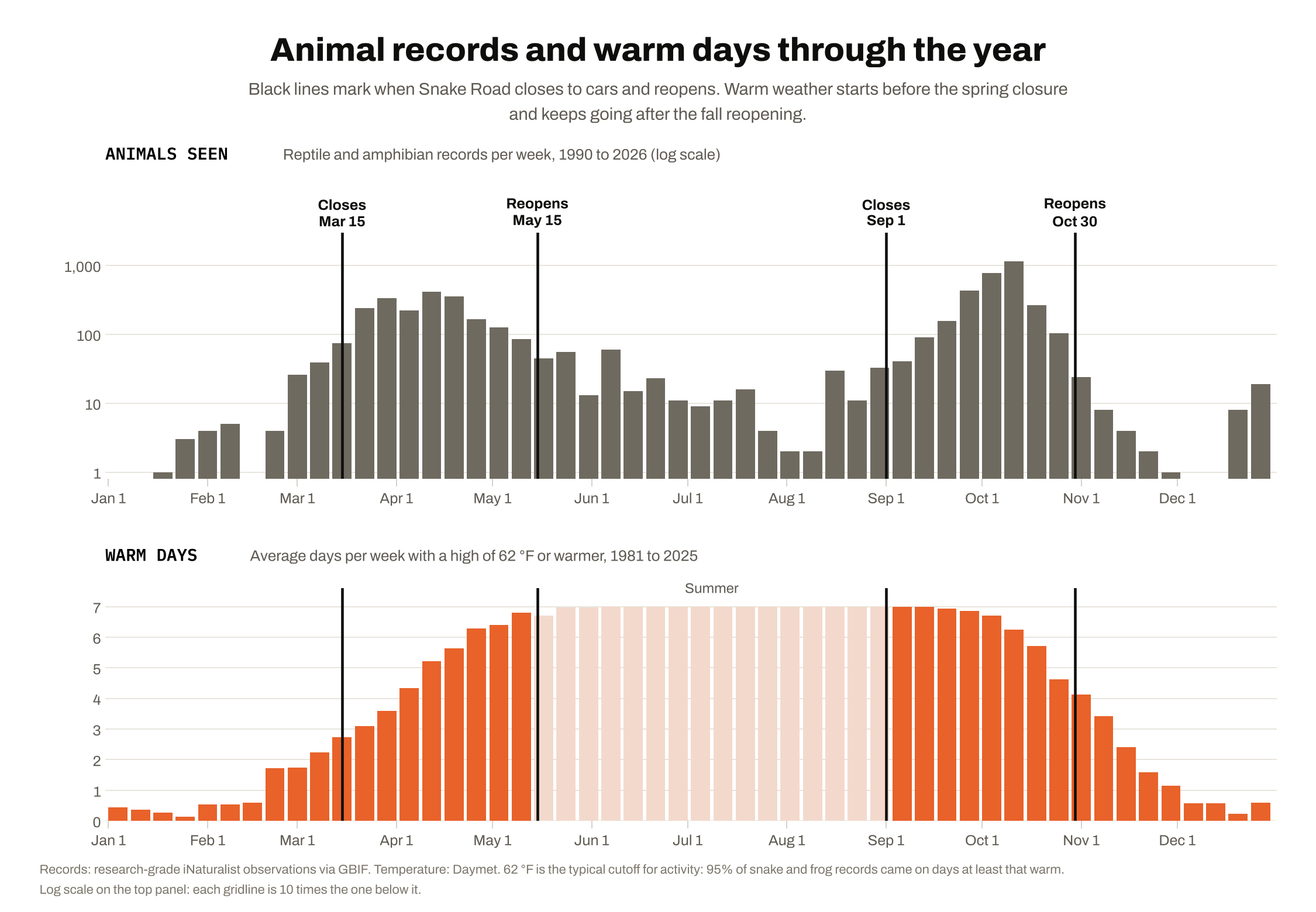
For the fall, the reopening date appears to come too early, according to the records. Every single year since 1981 had warm days after the road reopened. Days of 62 °F or warmer came about 13 times a year after the road reopened, and never fewer than 4 times. About half of those days fell in the first two weeks of November, a quarter in late November, and a sixth in December (Figure 1).
Late-season herpetological occurrences reflect these warm days. I found 30 records of snakes and frogs after the road reopened. Nearly all of them came after the first real cold snap of the fall, which tells me animals shut down when it turns cold and come back out on warm afternoons. On December 31, 2021, the high hit about 66 °F, and people logged six cottonmouths, ratsnakes (Pantherophis alleghaniensis), a Mississippi green watersnake (Nerodia cyclopion), a Blanchard’s cricket frog (Acris blanchardi), and a southern leopard frog (Lithobates sphenocephalus). A cottonmouth turned up on December 27, 2025. Keep in mind how few people are out there after the road opens. Every one of these records stands in for a lot of animals nobody photographed or noticed.
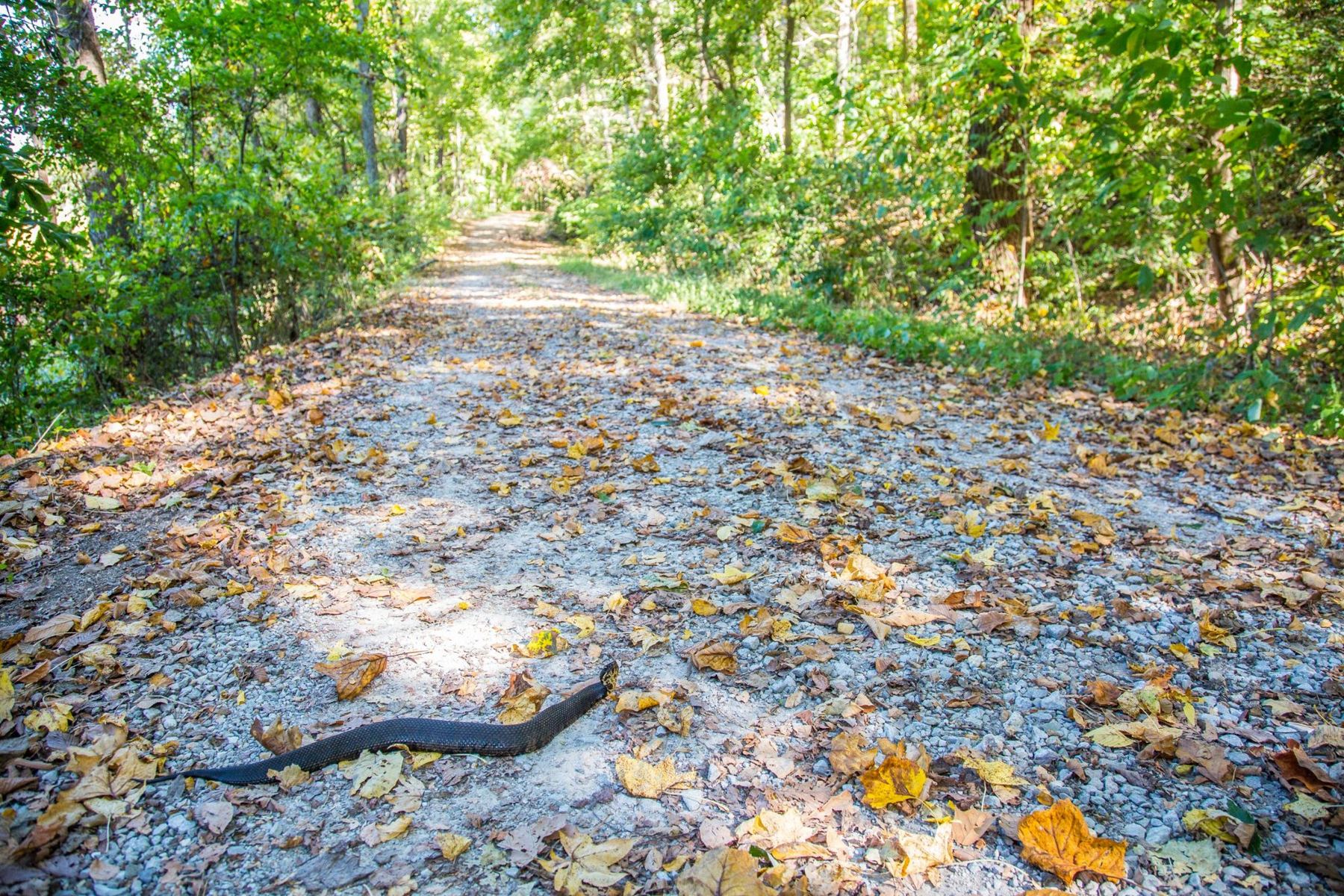
Fall is also where the only climate signal shows up in the historical data. The first cold stretch of the fall has been arriving about two days later each decade. Obviously there will be warm days after October in the region, but how many warm days would really be necessary to close the road longer?
What About the Future?
The problem I worry about here is whether fixed closure dates can keep up with a changing climate. So to look ahead, I ran future daily temperatures from seven high-resolution climate models through the same thresholds, comparing 2030 to 2049 with 1991 to 2020. These use a high-emissions scenario, so treat them as the upper end of what’s likely. Over the baseline years the models matched the real weather closely, which gave me some confidence in the rest.
In spring, crossing starts about 11 days earlier on average, moving from about March 20 to about March 9. The share of years when animals are crossing before the road closes nearly doubles, from about one in three to three in five. By the 2040s, March 15 would be too late more often than not.
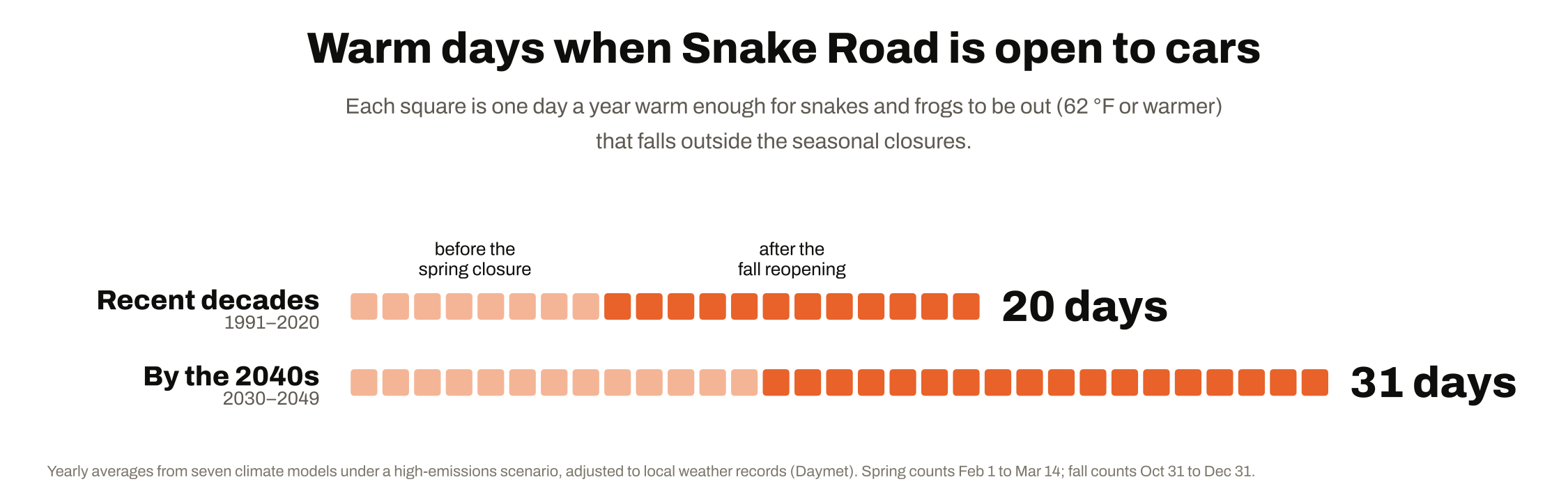
In fall, days of 62 °F or warmer after October 30 increase by about half, from about 12 a year to about 18. The lowest future model was still higher than the highest baseline model, so the models agree on the direction even when they disagree on the amount. The first cold stretch moves five to seven days later, close to October 30 itself. Counting both seasons together, warm days while the road is open to cars go from about 20 a year to about 31 (Figure 2).
Some limits to this work are that citizen science records come from wherever people happen to be. Warm days bring out visitors as well as animals, so some of the clustering of records on warm days reflects who was out looking. This is a well-known problem. Temperature is one of the strongest predictors of when people go out and record wildlife (Rosário et al., 2025), and iNaturalist records don’t carry any information about how hard people were looking (Di Cecco et al., 2021). The models assume animals will respond to the same temperatures in the future that they do now. Some research suggests the time of year matters too; a study of reticulated flatwoods salamanders (Ambystoma bishopi; Brooks et al., 2019) found that date predicted movement even after accounting for weather. If Snake Road’s animals work the same way, these projections overstate how far timing will shift.
What Should Change?
None of these results indicate the road closures are unsuccessful. The closures have protected countless animals for over 50 years and have helped make Snake Road a model of success for herpetological conservation and public outreach. As the road has grown in popularity over the years, it’s hard for me to imagine how many positive interactions have been had on the road between those who are skeptical of snake interactions and a basking cottonmouth, unaware of the ambassador role it is filling for its kind. Extending the closure dates as weather calls for it is a great practice and I just hope that enough people keep their eyes on the weather, and animal movement, for closures to be extended as thoroughly as possible. Based on the data, keeping the fall closure in place until mid-November would cover about half of the warm days that now fall after the reopening, and short closures whenever forecast highs reach the low 60s °F would cover much of the rest.
In my personal opinion, I think the road should be permanently closed. I don’t live in Wolf Lake, the small town near the road, and have no reason to use this road for transportation, but if I did, the 15-minute detour on the nearby highway wouldn’t bother me. Outside of research and management, I see little reason for this road to stay open. The road is growing in popularity and the Forest Service would benefit from keeping this area as healthy as possible, increasing the odds a group visiting gets to experience a positive interaction with some of the most misunderstood animals around. Keeping the road closed year-round would contribute to this by avoiding unnecessary vehicle mortality for crossing animals.
How You Can Help
If you are interested in Snake Road and would like to help to inform closure decisions, consider becoming a part of the Snake Road Sentinels, a volunteer program run by Illinois Extension in partnership with the Forest Service (Illinois Extension, n.d.). This program engages naturalists in walking the road, recording the snakes they see, and surveying the people visiting, giving managers a better picture of what’s happening on the road. Volunteers are always welcome. For more on the program, information can be found on Illinois Extension’s Snake Road Sentinels page.
If you don’t have time to volunteer but would still like to help the animals of the area, being mindful and considerate of the wildlife goes a long way, especially on busy days. If you’re at Snake Road after it reopens and the afternoon is warm, park and walk the road. You’ll see more on foot, and you won’t be the one who runs something over. If you find a dead animal on the road, log it. Dead-on-road records are some of the most useful data there is for questions like this one. If you notice any guests on the road not following rules of the area (handling animals, driving or biking the road while it’s closed, carrying hooks, tongs, or snake bags; U.S. Forest Service, n.d.), report it to the Official Shawnee National Forest Law Enforcement Tip Line at 618-201-3364.
Sources
- Ballard, S. R. (1994). Status of the herpetofauna in the LaRue-Pine Hills/Otter Pond Research Natural Area in Union County, Illinois [Master’s thesis, Southern Illinois University Carbondale].
- Brooks, G. C., Smith, J. A., Gorman, T. A., & Haas, C. A. (2019). Discerning the environmental drivers of annual migrations in an endangered amphibian. Copeia, 107(2), 270–276. https://doi.org/10.1643/CH-18-068
- Di Cecco, G. J., Barve, V., Belitz, M. W., Stucky, B. J., Guralnick, R. P., & Hurlbert, A. H. (2021). Observing the observers: How participants contribute data to iNaturalist and implications for biodiversity science. BioScience, 71(11), 1179–1188. https://doi.org/10.1093/biosci/biab093
- Gazette-Democrat. (2022, March 11). Forest Service notes Snake Road closed. https://www.annanews.com/news/forest-service-notes-snake-road-closed
- GBIF.org. (2026a, October 15). GBIF occurrence download: Amphibians [Data set]. https://doi.org/10.15468/dl.qndv2y
- GBIF.org. (2026b, October 15). GBIF occurrence download: Reptiles [Data set]. https://doi.org/10.15468/dl.vjm92z
- Haarsma, R. J., Roberts, M. J., Vidale, P. L., Senior, C. A., Bellucci, A., Bao, Q., Chang, P., Corti, S., Fučkar, N. S., Guemas, V., von Hardenberg, J., Hazeleger, W., Kodama, C., Koenigk, T., Leung, L. R., Lu, J., Luo, J.-J., Mao, J., Mizielinski, M. S., . . . von Storch, J.-S. (2016). High Resolution Model Intercomparison Project (HighResMIP v1.0) for CMIP6. Geoscientific Model Development, 9(11), 4185–4208. https://doi.org/10.5194/gmd-9-4185-2016
- Illinois Extension. (n.d.). Snake Road Sentinels. University of Illinois Urbana-Champaign. Retrieved November 5, 2026, from https://extension.illinois.edu/ajmpu/snake-road-sentinels
- Jesper, A. C., Eckert, S. A., Bielema, B. J., Ballard, S. R., & Dreslik, M. J. (2023). Phenology and predictors of spring emergence for the timber rattlesnake (Crotalus horridus). PeerJ, 11, Article e16044. https://doi.org/10.7717/peerj.16044
- Mominee, G. (2001). The road less traveled. Outdoor Illinois. https://www.lib.niu.edu/2001/oi010315.html
- Palis, J. G. (2016). Snakes of “Snake Road.” Bulletin of the Chicago Herpetological Society, 51(1), 1–9.
- Palmer, B. (2024, February 23). Snake Road closes early. WSIU Public Broadcasting. https://www.wsiu.org/community-updates/2024-02-23/snake-road-closes-early
- Rosário, I. T., Tiago, P., Chozas, S., & Capinha, C. (2025). When do citizen scientists record biodiversity? Non-random temporal patterns of recording effort and associated factors. People and Nature, 7(4), 860–870. https://doi.org/10.1002/pan3.70017
- Thornton, M. M., Shrestha, R., Wei, Y., Thornton, P. E., Kao, S.-C., & Wilson, B. E. (2022). Daymet: Daily surface weather data on a 1-km grid for North America, Version 4 R1 [Data set]. ORNL DAAC. https://doi.org/10.3334/ORNLDAAC/2129
- U.S. Forest Service. (n.d.). Respect wildlife. Shawnee National Forest. Retrieved November 5, 2026, from https://www.fs.usda.gov/r09/shawnee/safety-ethics/respect-wildlife
- U.S. Forest Service. (2012). LaRue Road closure (Forest Order No. R9-08-12-08). Shawnee National Forest. https://www.fs.usda.gov/r09/shawnee/alerts/larue-road-closure
- U.S. Forest Service. (2025, March 12). Shawnee National Forest closes Snake Road early for spring migration [Press release]. Shawnee National Forest. https://www.fs.usda.gov/r09/shawnee/newsroom/releases/shawnee-national-forest-closes-snake-road-early-spring-migration
- Zippenfenig, P. (2023). Open-Meteo.com Weather API [Computer software]. Zenodo. https://doi.org/10.5281/zenodo.7970649